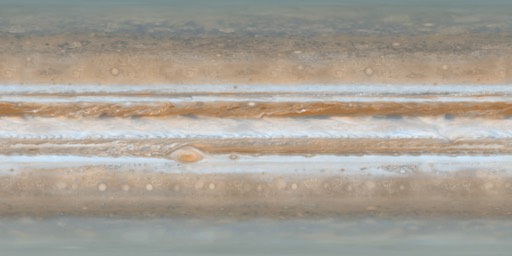
Key facts
- Mean diameter
- 139,820 km
- Mass
- 1.898 × 10^27 kg (318 Earths)
- Surface gravity
- 23.1 m/s² (2.36 g)
- Escape velocity
- 59.5 km/s
- Mean temperature
- -110 °C
- Rotation period
- 9.9 hours
- Orbital period
- 4,331 days
- Mean distance from the Sun
- 778.5 million km
- Sunlight travel time
- 43 min 16.8 s
- Axial tilt
- 3.1°
- Confirmed moons
- 101
Moon counts as reported after the IAU Minor Planet Center announcements of March 2026. Counts change as new discoveries are confirmed.
Atmosphere
Mostly hydrogen and helium, with ammonia clouds in colourful bands; temperature quoted at the 1-bar level.
Composition and structure
Gas giant; may contain a dense, diffuse core beneath metallic hydrogen.
Discovery and exploration
Galileo discovered its four largest moons in 1610. Pioneer 10/11, Voyager 1/2, Galileo (orbiter, 1995–2003) and Juno (since 2016) have studied it. ESA's JUICE and NASA's Europa Clipper are en route.
Major moons
- Io — The most volcanically active body known, heated by tidal flexing.
- Europa — An ice-covered moon hiding a global salty ocean.
- Ganymede — The largest moon in the Solar System, bigger than Mercury.
- Callisto — One of the most heavily cratered surfaces in the Solar System.